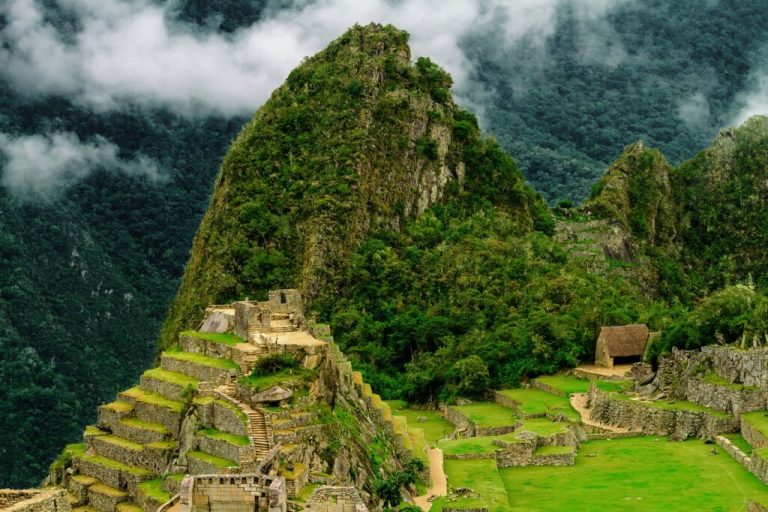
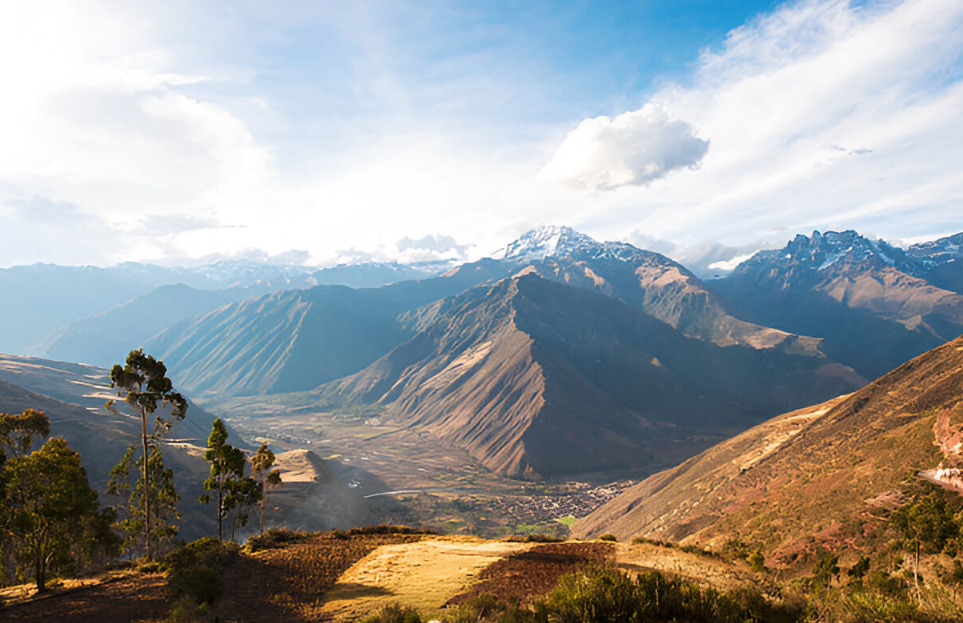
The Sacred Valley runs 60 km between Pisac and Ollantaytambo along the Urubamba River. It sits lower than Cusco — around 2,800 m against 3,400 m — which makes it the better place to spend a first night at altitude. The valley was the Inca Empire’s agricultural heartland and still produces most of the maize eaten in Cusco today.
At the eastern end, Pisac has a Sunday market and a hillside fortress with terraces running down to the river and Inca tombs cut into the opposite cliff. Ollantaytambo at the western end is the only Inca town still laid out on its original grid; six massive pink porphyry blocks still stand at the half-finished Temple of the Sun on the ridge above the plaza, and the fortress is where Manco Inca defeated a Spanish cavalry force in 1537 by flooding the terraces.
In between, Chincheros runs a weaving cooperative where textiles are dyed with cochineal and indigo; Maras has a cascade of 4,500 pre-Inca salt pans; Moray has a set of circular agricultural terraces where the Inca ran altitude micro-climates for crop experiments.
Peruways runs the Sacred Valley loop as a day-trip or a two-day. Book at Peruways.